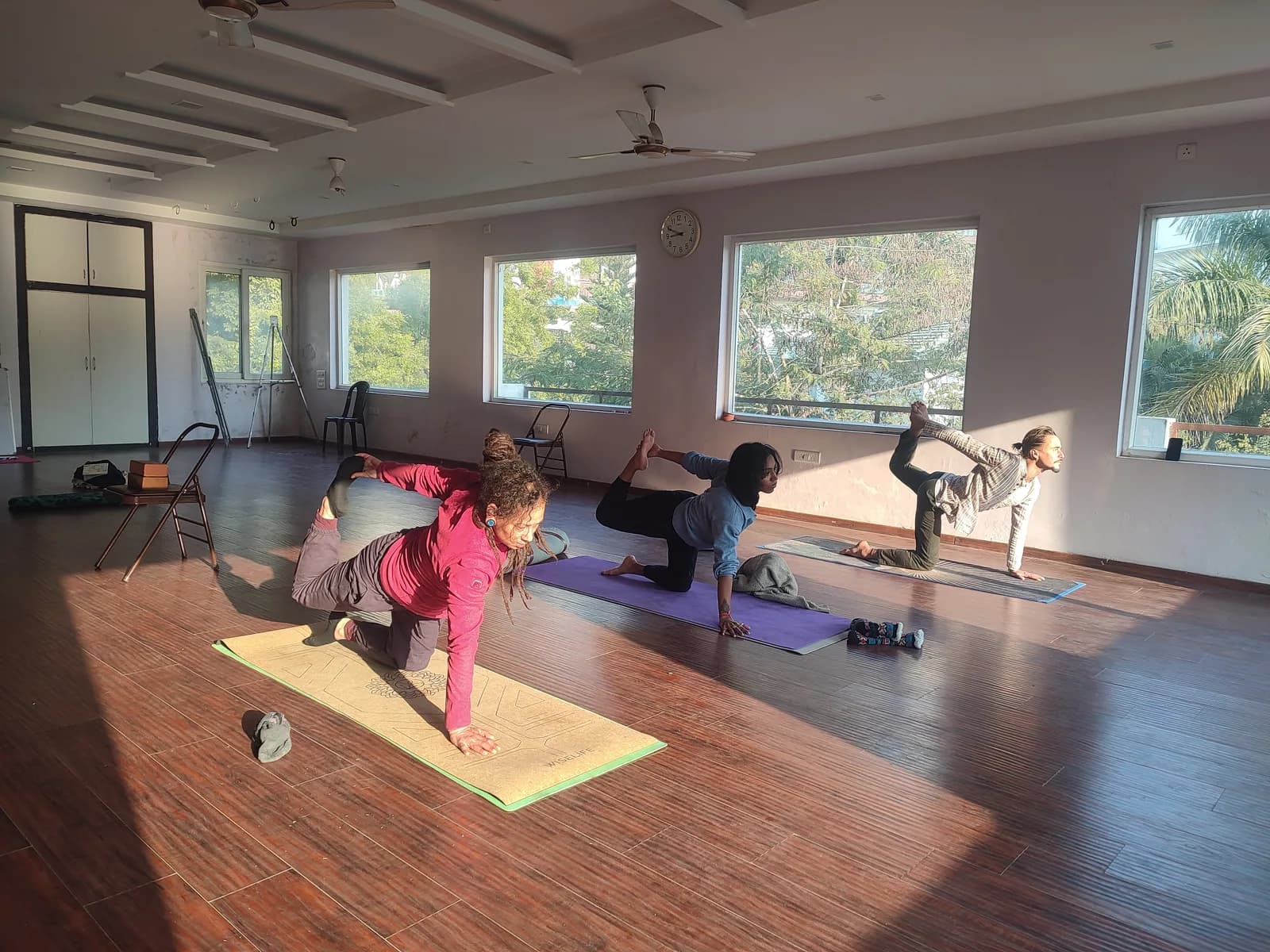
500-Hour Yoga Teacher Training in Rishikesh: A Complete Guide
Everything you need about the 500-hour yoga teacher training in Rishikesh — combined vs separate paths, curriculum depth, costs, and what RYT-500 actually unlocks.
Sudhanshu Badoni
Main Teacher · Lead FacultyMain teacher at Deep Yoga, Tapovan. Runs the YogaAsana YouTube channel (4K+ subs). · 12 yrs teaching
TL;DR
A 500-hour yoga teacher training in Rishikesh is the highest individual Yoga Alliance credential (RYT-500), held by under 15% of registered teachers worldwide. The combined 8-week residential path costs roughly $400 less than splitting 200hr + 300hr, and is the standard prerequisite for leading retreats, opening studios, and yoga therapy programs.
- Duration (combined): 54 days residential, ~8 weeks
- All-in budget: $5,000–$5,500 USD including flights, visa, insurance
- Outcome: RYT-500 with Yoga Alliance, recognized in 100+ countries, qualifies for IAYT yoga therapy pathways
According to Yoga Alliance, fewer than 15% of all globally-registered yoga teachers hold the RYT-500 — the credential that combines a 200-hour foundation with a 300-hour advanced training. It is also the standard prerequisite for becoming an E-RYT 500 (lead trainer of 200hr programs) and for most yoga therapy certification pathways recognized by the International Association of Yoga Therapists (Yoga Alliance RYS Standards).
If you have spent the last few years teaching weekly classes, watching your students change, and wondering whether your own training was deep enough — you have probably already started thinking about a 500-hour. The 500 hour yoga teacher training in Rishikesh is the longest, most demanding, and most internationally respected yoga teacher certification path you can take. It is also a real financial and time commitment, and it is not the right move for everyone. This guide walks through exactly what 500 hours of training actually delivers, the two paths to get there, who it suits, and why so many serious teachers choose Rishikesh over Bali, Thailand, or Costa Rica for this stage of their work.
What Is a 500-Hour Yoga Teacher Training?
A 500-hour yoga teacher training is the highest individual teaching credential issued by Yoga Alliance. It is the combined total of a 200-hour foundational training and a 300-hour advanced training, completed at Yoga Alliance Registered Yoga Schools (RYS-200 and RYS-300). On graduation, you become eligible to register as an RYT-500, and after sufficient post-certification teaching hours, an E-RYT 500 — the credential most lead trainers and studio owners hold worldwide.
Where the 200-hour program teaches you how to practice safely and lead a basic class, the 500-hour level prepares you to teach teachers, lead retreats, run advanced workshops, and work with students whose needs go beyond a typical group class. The Yoga Alliance E-RYT 500 framework adds depth across every category — anatomy, philosophy, pranayama, methodology, and ethics — and adds new categories most 200-hour programs barely touch, like teaching to special populations and the business of yoga as a profession. To see how this maps onto a specific syllabus, schedule, and faculty, read our full 500-hour yoga teacher training program page.
The Two Paths to RYT-500
Yoga Alliance recognizes two routes to the same credential. The route you choose depends on your time, money, and where you are in your teaching life.
Path 1: 200-Hour, Then 300-Hour Separately
Most teachers take this route. You complete a 200-hour yoga teacher training, return home, teach for one to three years, and then come back for a 300-hour advanced training. The advantage is real teaching experience between certifications. When you return for the 300-hour, you arrive with concrete questions about cueing, sequencing, dealing with injuries, and managing your own teaching nervous system. The advanced material lands harder because you have something to attach it to.
The trade-off is fragmentation. Months — or years — pass between the two trainings. You re-acclimate to Rishikesh twice. You pay two airfares. The total cost is typically $400 to $800 higher than the combined path.
Path 2: 500-Hour Combined Track
The combined path is one continuous immersion — approximately 8 weeks (54 days) without going home. You complete the 200-hour (27 days) and 300-hour (27 days) back to back, with a brief integration module bridging the two. The advantage is momentum. By the time the advanced material begins, the foundational asana, philosophy, and methodology are still fresh. You move into pranayama and Yoga Sutras study without needing a week of catch-up.
The trade-off is intensity and the absence of real-world teaching experience between levels. Eight weeks of dawn pranayama, two daily asana sessions, philosophy lectures, and filmed practicums is genuinely demanding. You also don't get to test the 200-hour material on real students before going deeper. For some practitioners, that's a feature — uninterrupted depth. For others, it's a reason to split the path.
Both paths produce the same RYT-500 eligibility. Yoga Alliance does not differentiate between them on your registration. Choose based on your circumstances, not on which route is "better."
Daily Schedule and Curriculum Depth
A 500-hour training in Rishikesh runs on a rhythm that is closer to ashram life than to a wellness retreat. Days begin before sunrise and run with structured breaks until evening satsang. Here is what the curriculum looks like across both halves.
Pranayama Mastery
By the 300-hour stage, pranayama is no longer a five-minute opener for an asana class. It becomes a standalone daily discipline of 60 to 90 minutes. You progress through Kapalabhati at increasing speeds, Bhastrika with Mula Bandha and Uddiyana Bandha engagement, extended Kumbhaka (breath retention), and Surya Bhedana and Chandra Bhedana for energetic balancing. You study contraindications in detail — why Kapalabhati is inappropriate for students with unmanaged hypertension, why Bhastrika is contraindicated in pregnancy, why retention practices require gradual progression over weeks.
Advanced Asana
The 500-hour level shifts emphasis from learning postures to understanding them. You spend less time drilling new shapes and more time on alignment refinement, peak pose preparation, sequencing logic, and modifications for injury. Inversions, arm balances, and deep backbends are taught with progressive preparation rather than dropped in as showpieces. You learn to assess a student's body and predict where they will struggle — knee tracking in lunges, shoulder packing in Chaturanga, hip rotation in Pigeon — and adjust the sequence in real time.
Philosophy: Yoga Sutras and Bhagavad Gita
Philosophy at the 500-hour level means sustained textual study. You work through the four padas of Patanjali's Yoga Sutras line by line, studying the Sanskrit terms, multiple translations, and commentarial traditions. You read full chapters of the Bhagavad Gita, mapping Karma Yoga, Jnana Yoga, and Bhakti Yoga as distinct paths. You study sections of the Hatha Yoga Pradipika to understand why its Shatkarma instructions exist in a specific developmental sequence. In Rishikesh, these modules are often led by scholars from local lineages with decades of textual practice — depth that is genuinely difficult to find at this scale anywhere else.
Teaching Methodology
By the time you reach the 300-hour portion of a 500-hour, methodology becomes the largest single block. You design and deliver full 60- and 75-minute classes — first to peers, then to external students. Sessions are filmed. You sit with a mentor and review your voice, your physical positioning, your adjustment timing, your ability to read the room and modify the plan. You receive written feedback and teach again. By graduation, you have a portfolio of multiple filmed classes spanning slow therapeutic, dynamic vinyasa, pranayama-focused, and specialized formats.
Anatomy and Yoga Therapy Foundations
Anatomy expands from "what muscle does what" to fascial line theory, nervous system regulation through breath and posture, and energetic anatomy (nadis and chakras understood as physiological maps rather than mystical metaphors). You study common injury patterns — sacroiliac dysfunction, shoulder impingement, lumbar disc compression — and the asana and pranayama interventions that support recovery. This isn't yoga therapy certification, but it is the foundation that makes one possible.
The Business of Yoga
This is the category most 200-hour programs skip entirely. At the 500-hour level you study the actual mechanics of yoga as a profession: studio economics, retreat pricing, online platform setup, Yoga Alliance continuing education requirements, contracts with studios, ethics of social media presence, and how to build a sustainable teaching practice that doesn't burn out by year three.
A Representative Daily Schedule
- 5:00 AM — Wake. Shatkarma cleansing practices on rotation: Jala Neti, Sutra Neti, Trataka.
- 5:30 AM — Pranayama. Open-air shala overlooking the Ganges. Progressive sequence — calming techniques first, then activating, then retention.
- 6:30 AM — Meditation. Seated silent practice, progressing from guided to unguided across the training.
- 7:00 AM — Asana practice. Two hours, alternating Hatha alignment days with Vinyasa flow days. Senior faculty leading.
- 9:00 AM — Breakfast. Sattvic vegetarian; communal; eaten in relative silence.
- 10:00 AM — Philosophy or anatomy lecture. Textual study, group discussion, written reflection.
- 12:00 PM — Teaching methodology workshop. Sequencing labs, adjustment clinics, voice training.
- 1:00 PM — Lunch and rest.
- 3:00 PM — Practicum. Students teach in rotation; filmed sessions twice weekly.
- 5:00 PM — Elective or self-study. Mantra, kirtan, additional pranayama, or personal practice.
- 6:30 PM — Dinner.
- 7:30 PM — Satsang or guest lecture. Two to three evenings per week.
- 9:00 PM — Silence. Lights out by 10:00 PM.
One day per week is free. Most students walk to Triveni Ghat for the evening Aarti, hike the trail to Neer Garh waterfall, visit the Beatles Ashram, or simply rest. Rest is not a luxury at this volume — it is what keeps the training sustainable.
Who Is the 500-Hour Right For?
This level of training is genuinely not for everyone. It is right for you if:
- You are a 200-hour graduate who knows you want to go all the way. If you completed your 200-hour and finished it thinking "this isn't enough," the 500-hour combined path lets you keep momentum without re-acclimating.
- You are already teaching and have hit a ceiling. Your classes are competent, your students return, but your sequences follow templates rather than principles. You want to teach from understanding rather than repetition.
- You plan to lead teacher trainings, run retreats, or open a studio. The RYT-500 is a baseline credential for these career paths. It is also a prerequisite for most yoga therapy certification programs (IAYT and similar).
- You are a serious practitioner who wants the depth, not the title. A meaningful number of 500-hour graduates never plan to teach professionally. They want the comprehensive study of pranayama, philosophy, and self-inquiry that this length of training enables.
It is not the right move if you completed your 200-hour less than six months ago and have not yet taught a single public class. You will benefit far more by teaching for a year or two first, building your own questions, and then returning for the 300-hour as a separate training. Depth without context is just information.
Investment: Time, Money, and Lifestyle
A 500-hour training in Rishikesh is a substantial commitment in all three dimensions. Be honest with yourself about each before applying.
Time. The combined path runs approximately 8 weeks (54 days). Split across two trips, you are looking at 4 weeks (200-hour, 27 days) plus another 4 weeks (300-hour, 27 days), for 8 weeks total of in-Rishikesh time, plus travel days. You also need to plan for at least a week of recovery and re-acclimation on each side — the schedule is intense enough that returning straight to a full work week is unrealistic.
Money. Rishikesh remains the most affordable serious training destination in the world. A combined 500-hour at Deep Yoga Wellness runs $3,800, which is typically $400 less than booking the 200-hour and 300-hour separately. Equivalent programs in Bali run $7,000 to $11,000. In Costa Rica, $8,000 to $14,000. In Europe, $9,000 to $16,000. The full per-day cost breakdown — tuition, accommodation, meals, flights, visa, insurance, personal expenses — is in our 2026 cost article. Budget at minimum $5,000 to $5,500 all-in for the combined path including international travel.
Lifestyle. You wake at 5:00 AM. You eat what is served. You don't drink alcohol or coffee for two months. You don't see your family in person. You share rooms (private upgrade is available but adds cost). The schedule is structured from morning to night, six days a week. For some practitioners, this stripped-down rhythm is the entire point — it's the conditions under which deep change is actually possible. For others, it's a known cost worth paying for the credential and the depth.
What 500-Hour Graduates Actually Do
The credential is meaningful only because of what it enables. Here is what a representative cross-section of RYT-500 graduates do in the years after certification.
- Studio owners. A meaningful number of graduates use the 500-hour as the credential and confidence base for opening their own studio. The business of yoga module covers the actual mechanics — leases, insurance, scheduling, instructor contracts.
- Retreat leaders. Hosting your own week-long retreats (in Bali, Mexico, Portugal, or anywhere else) requires the depth to fill seven days of programming and the credibility to charge $1,500 to $3,000 per attendee. The 500-hour is what most attendees expect their lead teacher to hold.
- Teacher trainers. To lead a Yoga Alliance RYS 200-hour training as the primary lead, you need at least an E-RYT 500 (RYT-500 plus 2,000 teaching hours). Most lead trainers begin building this resume immediately after their 500-hour.
- Specialized teachers. Prenatal, yoga for athletes, trauma-informed yoga, yoga for seniors, yoga therapy adjuncts — most specialty certifications use RYT-500 as the prerequisite.
- Online instructors. Building a paid online platform (membership site, on-demand library, personal app) is significantly easier when the marketing copy can credibly say "500-hour certified." It is the credential that makes student trust possible at scale.
- Corporate and clinical teachers. Hospitals, rehabilitation programs, and corporate wellness contracts almost always require RYT-500 minimum.
None of these outcomes are guaranteed by the credential alone. The 500-hour is the foundation; what you build on top of it is the work of the next several years.
Why Rishikesh Specifically for the 500-Hour
You can do a 500-hour in Bali, Costa Rica, Portugal, Thailand, or any number of Western destinations. There are good reasons to choose Rishikesh for this specific level of training, and the reasons are different from the reasons that draw people for the 200-hour.
Depth of philosophy. The 500-hour curriculum is heavy on textual study — Patanjali's Yoga Sutras, Bhagavad Gita, Hatha Yoga Pradipika. Rishikesh has a density of scholars from multigenerational lineages that simply does not exist anywhere else in the world. When you study the Sutras here, you study them with people whose families have studied them for centuries.
Authenticity without performance. Yoga is not an import in Rishikesh. It is a living cultural practice. The morning Ganga Aarti at Triveni Ghat happens whether tourists show up or not. The ashrams run for residents, not for content. The food, the language, the rhythm of the day are not arranged around your training — your training is arranged around them.
The Ganges and the river-air pranayama. The geographic conditions matter for pranayama work specifically. The cool, clean morning air at the foothills of the Himalayas creates breathing conditions that an indoor heated studio in Bali or Costa Rica cannot replicate. Lung capacity and breath control develop measurably faster.
Cost. The depth-per-dollar in Rishikesh is unmatched. You can complete a serious 500-hour here for a third of what an equivalent program costs in Europe.
Rishikesh is not romantic. It is dusty, the cows are real, the power flickers, and the Wi-Fi is unreliable. The schools that try to sell it as a luxury destination are usually the ones to avoid. The schools that treat it as a working environment for serious training are the ones worth flying to. For a deeper read on how to tell the difference, see our guide to choosing a yoga school in Rishikesh.
How Deep Yoga's 500-Hour Differs
There are over 300 yoga schools in Rishikesh offering 200-hour training, and a smaller but still significant number offering 300-hour and 500-hour paths. Here is what we do differently at Deep Yoga Wellness.
Cohort size. Our 500-hour cohorts are capped at 20 to 30 students. This is not a boutique operation pretending to be exclusive — it is a practical limit. Above 30 students, the filmed practicum review loses fidelity, the philosophy seminars become lectures rather than discussions, and individual mentorship becomes impossible. Below 15, the cohort dynamic itself loses something. We have settled on 20 to 30 as the size where the work actually happens.
Bridge curriculum. Most schools that offer a 500-hour combined path simply run the 200-hour and 300-hour programs back to back with a weekend off in between. Our combined path includes a dedicated 4-day integration module between the two halves. We use it to consolidate the 200-hour material, address the questions that have surfaced during the foundational weeks, and prepare specifically for the increased intensity of the 300-hour pranayama and philosophy work. Students who have taken both paths consistently report that this bridge module is what makes the combined experience feel coherent rather than fragmented.
Faculty continuity. The same lead faculty teach every cohort. We do not rotate freelance instructors through the program. Continuity matters because the curriculum is integrated — your philosophy teacher in week 8 has watched your filmed practicums in week 6 and knows the questions you've been wrestling with.
Alumni community. Graduates of our 500-hour join an active alumni network — quarterly Zoom satsangs with the lead faculty, ongoing mentorship for graduates teaching their first courses, a private referral channel for retreat collaborations and teaching opportunities. The credential is the start of the relationship, not the end.
Yoga Alliance certified, fully transparent. Deep Yoga Wellness is a Yoga Alliance Registered Yoga School (RYS-200 and RYS-300). Our faculty hold E-RYT 500 credentials and have been leading teacher trainings for over a decade. We list our registration numbers on the course page; verify them directly on the Yoga Alliance website before enrolling at any school, here or elsewhere.
Next Steps
If you are ready to begin, the application process at Deep Yoga is straightforward. Review the 500-hour course page for upcoming dates, full curriculum, faculty bios, and the application form. Cohorts run three to four times per year and typically close 8 to 12 weeks before the start date.
If you are still deciding between the combined path and taking the 200-hour and 300-hour separately, read the 200-hour guide and the 300-hour guide first, then sit with the question for a week. The answer is usually clearer than it feels in the moment.
If you are not yet a 200-hour graduate and the 500-hour combined path is calling, that is also a valid place to start. The combined track is designed as a complete journey from committed practitioner to RYT-500. You do not need a prior certification — you need six months of regular practice, a willingness to live by a 5:00 AM bell for eight weeks, and the honesty to know whether this is the right time in your life.
The work is real. The certification is recognized in over 100 countries. And the people who finish it almost always say the same thing about Rishikesh: that something happened here that would not have happened anywhere else.
Frequently asked questions
What is a 500-hour yoga teacher training?
A 500-hour yoga teacher training is the highest individual teaching credential issued by Yoga Alliance, combining a 200-hour foundational training with a 300-hour advanced training. On graduation, you become eligible to register as an RYT-500 — a credential held by fewer than 15% of registered yoga teachers worldwide and required for leading teacher trainings, opening studios, and most yoga therapy programs.
Should I take the 500-hour as one combined path or do the 200-hour and 300-hour separately?
Both paths produce the same RYT-500 credential. The combined path (54 days, approximately 8 weeks in Rishikesh) gives you uninterrupted depth and is usually $400 to $800 cheaper. Taking them separately gives you real teaching experience between the two trainings, which makes the advanced material more immediately applicable. Choose the combined path if you can commit eight weeks and want continuity. Choose the separate path if you want to teach for a year or two before going deeper.
How long does a 500-hour yoga teacher training in Rishikesh take?
The combined 500-hour path at Deep Yoga Wellness runs 54 days (approximately 8 weeks). It is the 200-hour (27 days) and the 300-hour (27 days) taken back-to-back, with no gap and no re-entry shock — the math is 27 + 27 = 54 days of unbroken immersion.
Do I need to be a 200-hour graduate before enrolling in a 500-hour combined program?
No. The combined 500-hour path is designed as a complete journey from committed practitioner to RYT-500 and does not require a prior certification. You do need a minimum of six months of regular yoga practice. If you already hold a 200-hour from another Yoga Alliance Registered Yoga School and want to add the 300-hour separately, that is also a valid path.
How much does a 500-hour yoga teacher training in Rishikesh cost?
A combined 500-hour at Deep Yoga Wellness costs $3,800, which is typically $400 less than booking the 200-hour and 300-hour separately. Budget approximately $5,000 to $5,500 all-in including international flights, visa, travel insurance, and personal expenses. Equivalent 500-hour programs in Bali run $7,000 to $11,000; in Costa Rica $8,000 to $14,000; in Europe $9,000 to $16,000.
Is the RYT-500 certification from Rishikesh recognized internationally?
Yes, provided you train at a school registered with Yoga Alliance as an RYS-200 and RYS-300 (or RYS-500). Upon completion, you can register as an RYT-500 with Yoga Alliance, which is recognized in over 100 countries including the United States, Canada, the United Kingdom, Australia, and across Europe. The RYT-500 is also the standard prerequisite for most yoga therapy certification programs and for serving as a lead trainer at a Yoga Alliance Registered Yoga School.
What can I do with an RYT-500 that I cannot do with an RYT-200?
The RYT-500 is the baseline credential for leading Yoga Alliance teacher trainings (combined with 2,000 teaching hours to become an E-RYT 500), pursuing yoga therapy certification through IAYT, teaching at most premium studios and retreat centers, securing hospital and corporate wellness contracts, and credibly leading your own retreats and online platforms. An RYT-200 qualifies you to teach group classes; an RYT-500 qualifies you to teach teachers and lead at scale.