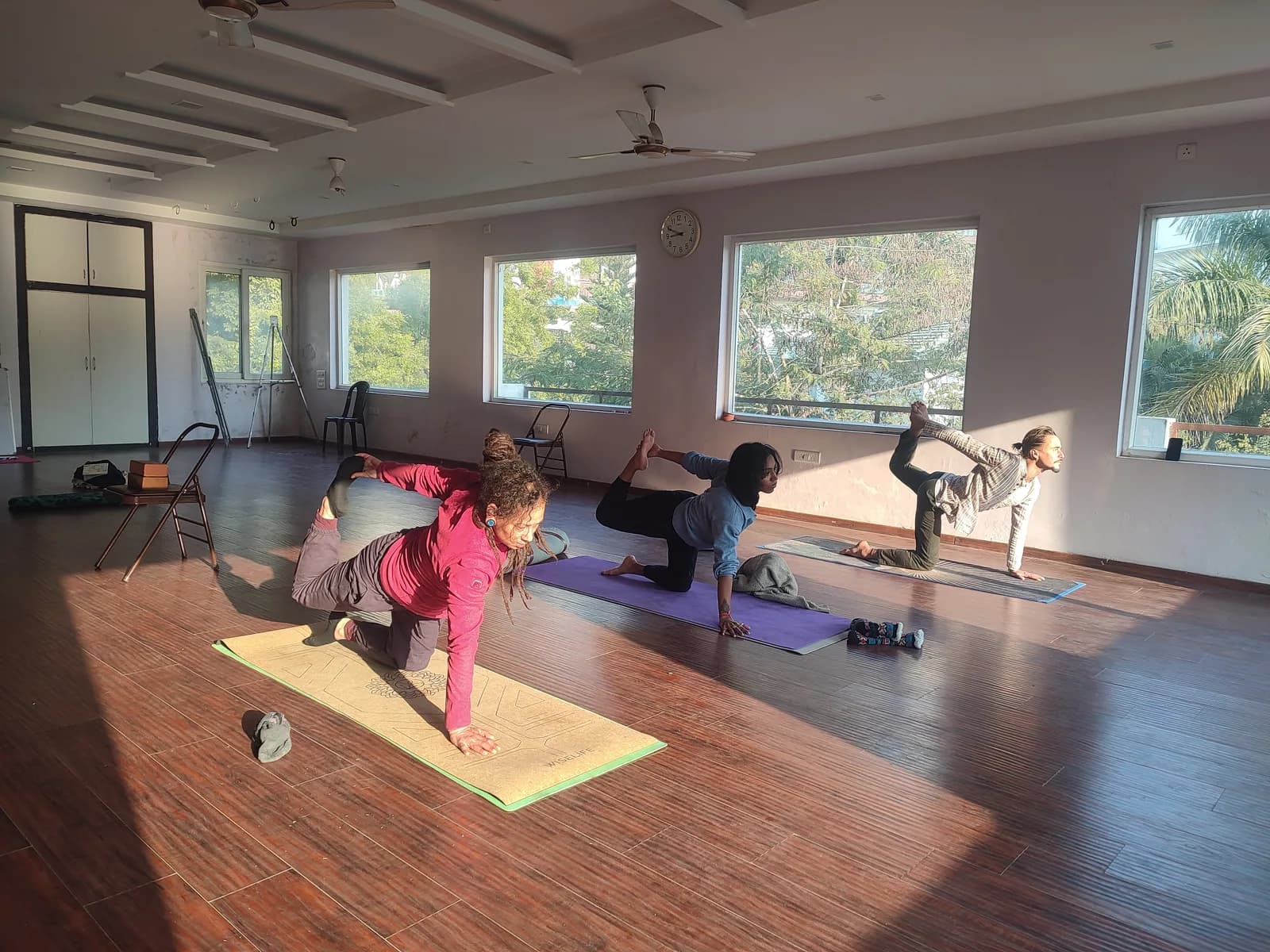
Daily Schedule of a Yoga Teacher Training in Rishikesh
Hour-by-hour breakdown of a typical day at a Rishikesh yoga teacher training — the 5 AM wake bell, two asana sessions, philosophy blocks and satsang.
Sudhanshu Badoni
Main Teacher · Lead FacultyMain teacher at Deep Yoga, Tapovan. Runs the YogaAsana YouTube channel (4K+ subs). · 12 yrs teaching
TL;DR
A typical day at a yoga teacher training in Rishikesh runs 5:00 AM to 9:00 PM and contains roughly seven hours of structured study — pranayama, asana, philosophy, anatomy, methodology, and practicum — across six days a week. One day off per week. The rhythm is intentionally dense; this is what 200 contact hours looks like compressed into 27 days.
- Wake bell: 5:00 AM — cleansing kriyas + pranayama before sunrise
- Asana sessions: 2 per day (morning + late afternoon)
- Free time: typically 3–4 hours mid-day for rest, study, journaling
Yoga Alliance requires a minimum of 200 contact hours to issue an RYT-200 certification, allocated across specified curriculum categories: 100+ hours of techniques training and practice, 30 hours of philosophy, 25 hours of teaching methodology, 20 hours of anatomy, 10 hours of practicum (Yoga Alliance RYS Standards). Compress those 200 hours into 27 residential days and you get the schedule below — a near-monastic daily rhythm that is the single most-asked-about feature of any Rishikesh yoga teacher training.
What a Typical Day Looks Like
The schedule below is representative of how most reputable Rishikesh schools — including Deep Yoga Wellness — structure their daily routine. Times shift slightly by school, by season, and by the specific lineage being taught, but the architecture is consistent.
| Time | Activity | Duration |
|---|---|---|
| 5:00 AM | Wake bell · cleansing kriyas (Jala Neti, Trataka) | 30 min |
| 5:30 AM | Pranayama on the rooftop or shala | 60 min |
| 6:30 AM | Mantra chanting · seated meditation | 30 min |
| 7:00 AM | Morning asana practice (Hatha or Vinyasa) | 120 min |
| 9:00 AM | Breakfast · sattvic vegetarian | 60 min |
| 10:00 AM | Yoga philosophy lecture (Yoga Sutras / Bhagavad Gita) | 90 min |
| 11:30 AM | Anatomy and physiology | 60 min |
| 12:30 PM | Lunch and rest | 150 min |
| 3:00 PM | Teaching methodology · adjustments workshop | 90 min |
| 4:30 PM | Practicum · peer-led teaching with feedback | 60 min |
| 5:30 PM | Evening asana practice (yin · restorative · alignment) | 90 min |
| 7:00 PM | Dinner | 60 min |
| 8:00 PM | Evening satsang · kirtan · Q&A · journaling | 60 min |
| 9:00 PM | Lights-out signal · silence until morning bell | — |
That is roughly seven hours of formal structured study, two hours of breath and meditation, and three hours of free time during midday. Days are intentionally arranged so the most demanding work happens in the cool morning hours, lighter classroom work fills the warmer midday, and the second physical practice closes the day before sunset.
Pre-Dawn Block: 5:00 AM – 6:30 AM
The day begins in the dark. A bell rings at 5:00 AM. Within twenty minutes, every student is on their cushion and the rooftop or shala is silent. The pre-dawn hour is reserved for the most internal practices — the ones traditional yoga places before any physical movement.
Cleansing kriyas (5:00–5:30): Most schools include some subset of the shatkarmas — the six classical cleansing practices. Jala Neti (warm-saline nasal cleansing) is universal. Trataka (focused gazing on a candle flame) appears in most programs. More advanced cleansings like Kapalabhati (skull-shining breath) are typically reserved for week two, after the body has adapted to the rhythm.
Pranayama (5:30–6:30): A full hour of breath work. Most schools begin with Nadi Shodhana for the first ten minutes, then move into one or two specific techniques each day on rotation — Bhramari, Surya Bhedana, Chandra Bhedana, Bhastrika in week three, with bandha-locked retentions reserved for the most experienced students. For the foundational techniques covered in this block, see our pranayama techniques beginner's guide.
Morning Practice: 7:00 AM – 9:00 AM
The longest single block of the day is the morning asana practice. Two hours of led practice in a softly-lit shala as the sun rises through the windows.
Schools alternate between Hatha (alignment-focused, longer holds, classical sequencing) and Vinyasa (flow-based, breath-led, sun salutation framework) on a daily rotation. Some schools also include weekly Ashtanga primary-series sessions for students who want to learn the canonical sequence in full.
The morning practice is when corrections happen most freely. Faculty walk the room. Hands-on adjustments are offered with consent. The room is full but not crowded — most reputable schools cap morning practice at 20–25 students per teacher to maintain hands-on accessibility.
Mid-Morning Block: 10:00 AM – 12:30 PM
After breakfast, the body shifts from movement to study. Two academic blocks back-to-back.
Yoga philosophy (10:00–11:30): Textual study. The Yoga Sutras of Patanjali are the spine of any 200-hour philosophy module — most schools work systematically through Pada I (Samadhi Pada) and at least the opening sutras of Pada II (Sadhana Pada) over the four weeks. Schools with stronger philosophical depth also introduce excerpts from the Bhagavad Gita, the Hatha Yoga Pradipika, and the Upanishads. Discussion is encouraged. Notebook full at the end of every session.
Anatomy and physiology (11:30–12:30): The musculoskeletal anatomy relevant to yoga — how the shoulder girdle moves in Chaturanga, why the sacroiliac joint is vulnerable in twists, what happens to the diaphragm during pranayama. Most schools use a skeleton model, anatomy textbooks, and live demonstration on willing students. The goal is functional understanding, not memorisation of every muscle origin.
Midday Rest: 12:30 PM – 3:00 PM
The longest free block. Lunch is the main meal of the day — dal, rice, seasonal vegetables, chapati, often a small dessert. Communal seating, often eaten in silence at the more traditional schools.
The two hours after lunch are deliberately unstructured. Most students nap for an hour, then journal, read assigned philosophy, review anatomy notes, walk to a riverside café for chai, or simply lie under a tree. This block is non-negotiable for sustainable practice. Without it, week two breaks most students.
Afternoon Block: 3:00 PM – 5:30 PM
The day's most teaching-focused block.
Teaching methodology (3:00–4:30): The mechanics of how to teach. Voice projection. Class sequencing — opening, peak pose, cool-down. Cueing — how to give a verbal instruction that lands. Reading the room. Managing mixed-level groups. How to demo without leaving the front of the room. How to give a hands-on adjustment with consent. This is the block where most students realise that knowing how to do a pose is unrelated to knowing how to teach it.
Practicum (4:30–5:30): Peer teaching. Each student takes turns leading short sequences (5 minutes early in the program, 30 minutes by week four) for the rest of the cohort while a faculty member observes. Feedback is honest and immediate. Filmed sessions are introduced in week three at most schools. The feedback loop is what turns a competent practitioner into a teacher.
Evening Practice: 5:30 PM – 7:00 PM
The second daily asana session. Different in character from the morning. Where the morning is dynamic and progressive, the evening is restorative — yin, alignment workshops, longer holds, props, restoratives, occasional Ashtanga primary-series practice for students wanting more dynamic afternoons.
The evening session is where the day's accumulated tension releases. By week two, students start to notice that the second practice integrates everything — the morning asana, the philosophy lecture, the methodology workshop, the practicum feedback — into a single embodied understanding.
Dinner and Satsang: 7:00 PM – 9:00 PM
Dinner is lighter than lunch. Soup, fresh chapati, a small portion of dal or vegetables. Then satsang — the gathering for evening practice.
Different schools handle the satsang differently. Some run kirtan (devotional chanting led by a harmonium). Some hold open Q&A with the lead faculty about that day's material. Some invite guest teachers — a visiting Sanskrit scholar, a senior monk from a nearby ashram — for short talks. Some have silent meditation. Most schools rotate through these formats over the course of a month.
Lights-out is signaled at 9:00 PM. The cumulative effect of waking at 5:00 AM, two physical practices, two academic blocks, methodology and practicum, and the evening sit is that sleep arrives easily by 9:30 PM at the latest.
The Weekly Rhythm
The schedule above runs six days a week. One day per week is free of formal classes — typically Sunday at most schools, occasionally Saturday at the more traditional ones.
The free day is genuinely free. Most students walk across the suspension bridge at Lakshman Jhula or Ram Jhula, visit the Beatles Ashram, sit at the Triveni Ghat for the evening Aarti, or hike to nearby waterfalls. Some students use the day to catch up on sleep, others to call home. A small minority do an extended self-practice. There is no judgment either way.
The weekly free day is structurally important. The schedule six days on, one day off matches the natural human capacity for sustained concentrated work. Schools that try to run seven days a week typically see student burnout by week three.
Why the Schedule Is Built This Way
The architecture of a Rishikesh YTT day is not arbitrary. Three principles drive the structure:
1. The most demanding work happens at the most cognitively rested hours. Pre-dawn pranayama and morning asana — when the body is fresh, the mind is uncluttered, and the air is cool — are scheduled before lunch. Philosophy and anatomy, which require sustained attention but less physical demand, fill the warmer midday. Methodology and practicum, where students are teaching peers, happen in the afternoon when energy is back up. Evening asana is intentionally restorative — closing the day's practice rather than opening a new one.
2. The traditional rhythm aligns with the body's natural cycles. Cortisol peaks in the early morning. The sympathetic nervous system is most active in the first three hours after waking. The yogic tradition uses this window for the most demanding practices because the body is biologically primed. By late afternoon cortisol has dropped and the parasympathetic nervous system is more accessible — perfect for evening yin and meditation.
3. The communal rhythm builds the sangha. Eating, practicing, studying, and resting on the same schedule with the same cohort for twenty-seven consecutive days creates a degree of cohort cohesion that scattered urban yoga classes cannot match. By day five, students know each other's alignment habits. By day fifteen, they're catching each other's teaching mistakes. By day twenty-five, they've become the people they will reference for years afterward as their first cohort.
What the Schedule Actually Feels Like
For the first three days, the schedule is exhausting. Most international students arrive jet-lagged. The 5:00 AM wake-up feels brutal. The two daily asana sessions surface every weakness in the body. By day three or four, soreness has set in everywhere.
By the end of the first week, something shifts. The body adapts. The schedule begins to feel less like an imposition and more like a structure that the day naturally falls into. Students start waking before the bell. The mid-day rest becomes deeply restorative rather than collapse-required.
By the end of the second week, the schedule has become invisible. It is no longer something you are doing; it is the rhythm of life. Most students describe this as the moment when the training stops being something they are surviving and starts being something they are inside of.
By week four, the prospect of returning to a life without 5:00 AM bells, two daily practices, communal meals, and structured silence feels strange. Many graduates report that the first week back home is harder than the first week of training was.
How Deep Yoga's Daily Schedule Differs
Most schools in Rishikesh follow a version of the schedule above. The differences between schools are usually at the margins — exact wake time (some 5:30, some 4:45), exact lunch length, exact weekly rest day. What separates schools at a deeper level is what happens inside each block, not the block's position on the timetable.
At Deep Yoga Wellness, three structural choices shape our daily schedule:
- Smaller cohorts during morning asana. We cap morning practice at 20 students per teacher so that hands-on adjustments are accessible. Larger schools (some run 50+ students per session) cannot maintain this density.
- Filmed practicum from week three onward. Each student is recorded during their teaching practicum at least twice, and reviews the video with a faculty mentor. This is one of the most concrete pedagogical advantages of any program. Most schools defer filming to the 300-hour module.
- Genuine philosophy lecturers. Our philosophy block is taught by faculty who can recite sections of the Yoga Sutras in Sanskrit from memory and who have spent decades engaging with the commentary tradition. This is rarer than it sounds; many schools subcontract philosophy to a freelance teacher who reads from translation.
For a complete program description — what each module covers, dates, pricing, accommodation tiers — see our 200-hour yoga teacher training program page or read the broader 200-hour complete guide.
Should You Be Worried About the Schedule?
Most prospective students worry about the schedule before they arrive. They are not wrong to. The 5:00 AM wake-up, two daily practices, sustained academic study, and limited free time are genuinely demanding.
What no article can quite communicate is that the schedule is also the point. Twenty-seven days of consistent rhythm produces changes — physical, mental, philosophical — that scattered urban yoga cannot. The discomfort of the first three days is a feature, not a bug. By the end of week four, the schedule becomes the gift.
The students who struggle most are not the ones with the least flexibility or the least prior practice. They are the ones who arrive expecting a yoga retreat. A yoga teacher training is not a retreat. It is a conservatory. The schedule is the curriculum. Honor it, and the month delivers.
Frequently asked questions
What time does a typical Rishikesh yoga teacher training start in the morning?
5:00 AM. The wake bell rings at 5:00, and most schools begin formal pranayama or cleansing practices by 5:30. The pre-dawn block is non-negotiable across all reputable Rishikesh schools — it is where the most internal practices traditionally happen, when the body is biologically primed and the air is fresh.
How many hours per day are spent in formal classes during a YTT?
Roughly seven hours of structured study (asana, pranayama, philosophy, anatomy, methodology, practicum), plus another two hours of breath work and meditation, plus shared meals and satsang. The total formal-time-on-cushion-or-in-classroom is roughly nine hours daily, six days a week, totaling 200+ contact hours over 27 days as required by Yoga Alliance.
Is there free time during a yoga teacher training in Rishikesh?
Yes. The midday block from approximately 12:30 PM to 3:00 PM is intentionally unstructured — long lunch, rest, journaling, walks. One full day per week (typically Sunday) is also free of formal classes. Without these breaks, sustained four-week training becomes unsustainable; the rhythm of six days on, one day off, plus a daily 2.5-hour midday rest, is what makes the schedule survivable.
What is satsang and is it mandatory in a Rishikesh yoga teacher training?
Satsang is the evening gathering — typically 8:00–9:00 PM — that closes the day. Different schools handle it differently: kirtan (devotional chanting with harmonium), open Q&A with lead faculty, guest lectures, or silent meditation. At most reputable schools, attendance is expected but not strictly enforced. The evening sit is genuinely valuable — it is when the day's material consolidates and questions that surfaced during practice get answered.
Why do Rishikesh yoga schools all start so early?
Three reasons: the body's cortisol peak in the early morning aligns with the demanding pre-dawn pranayama and asana practices; the cool morning air at the foothills of the Himalayas creates measurably better breathing conditions than warmer afternoon hours; and the traditional yogic tradition reserves the brahma muhurta (the 90 minutes before sunrise) for the most internal practices. The 5:00 AM wake is uncomfortable for the first three days and feels natural by week two.
Will I have time to explore Rishikesh during my yoga teacher training?
Yes, on the weekly rest day. Most students use it to walk across the suspension bridge at Lakshman Jhula or Ram Jhula, attend the evening Aarti at Triveni Ghat, visit the Beatles Ashram, or hike to nearby waterfalls. The midday free block during weekdays also allows short trips to nearby cafés or temples within Tapovan and Laxman Jhula. What is not realistic is multi-day trips to Delhi, Agra, or the mountains — you have to come back for the next morning's pranayama at 5:30 AM.