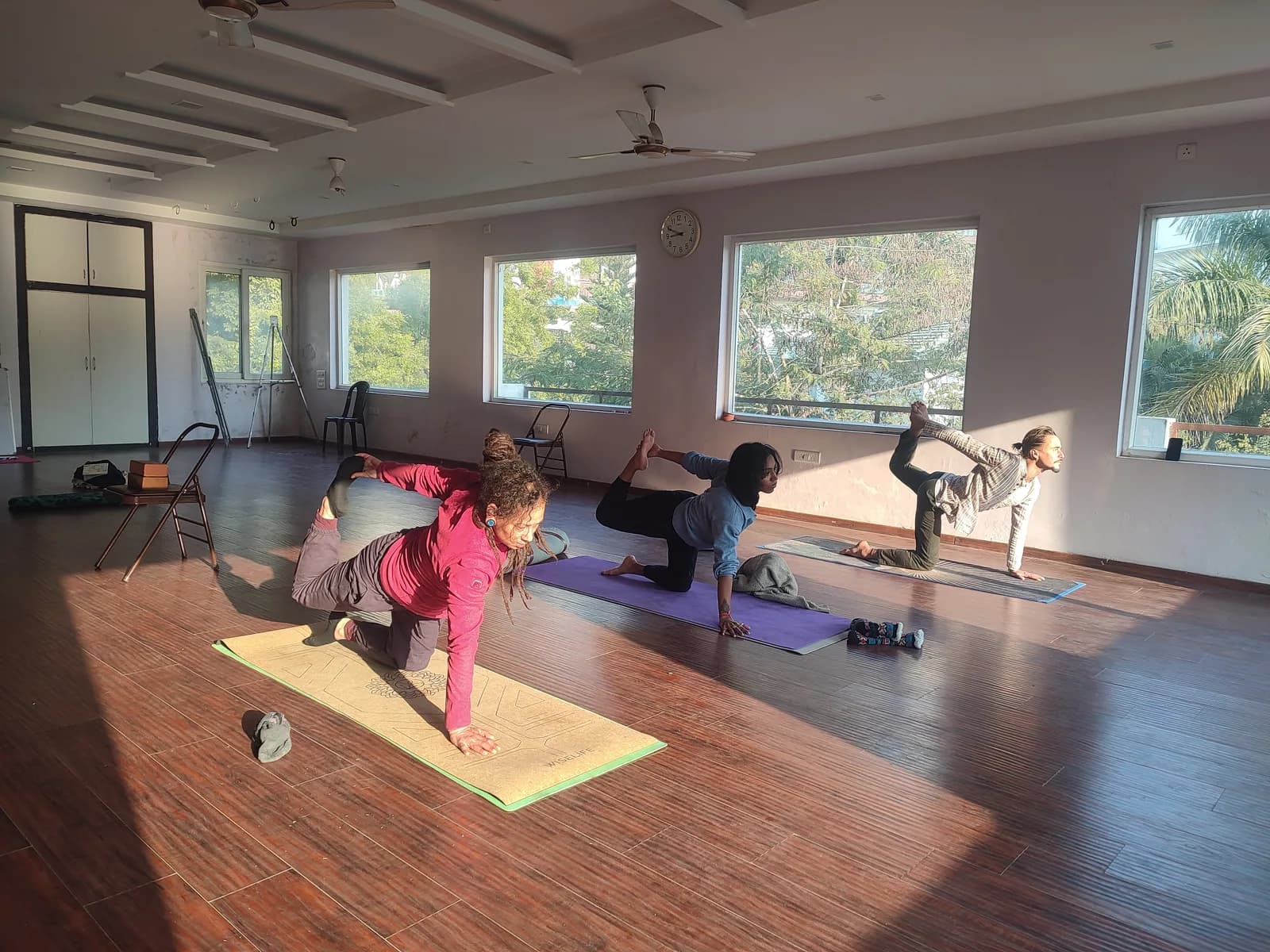
Yoga Philosophy: A Beginner's Introduction
A beginner's introduction to yoga philosophy — the four foundational texts, the eight limbs of yoga, key concepts, and where to start reading.
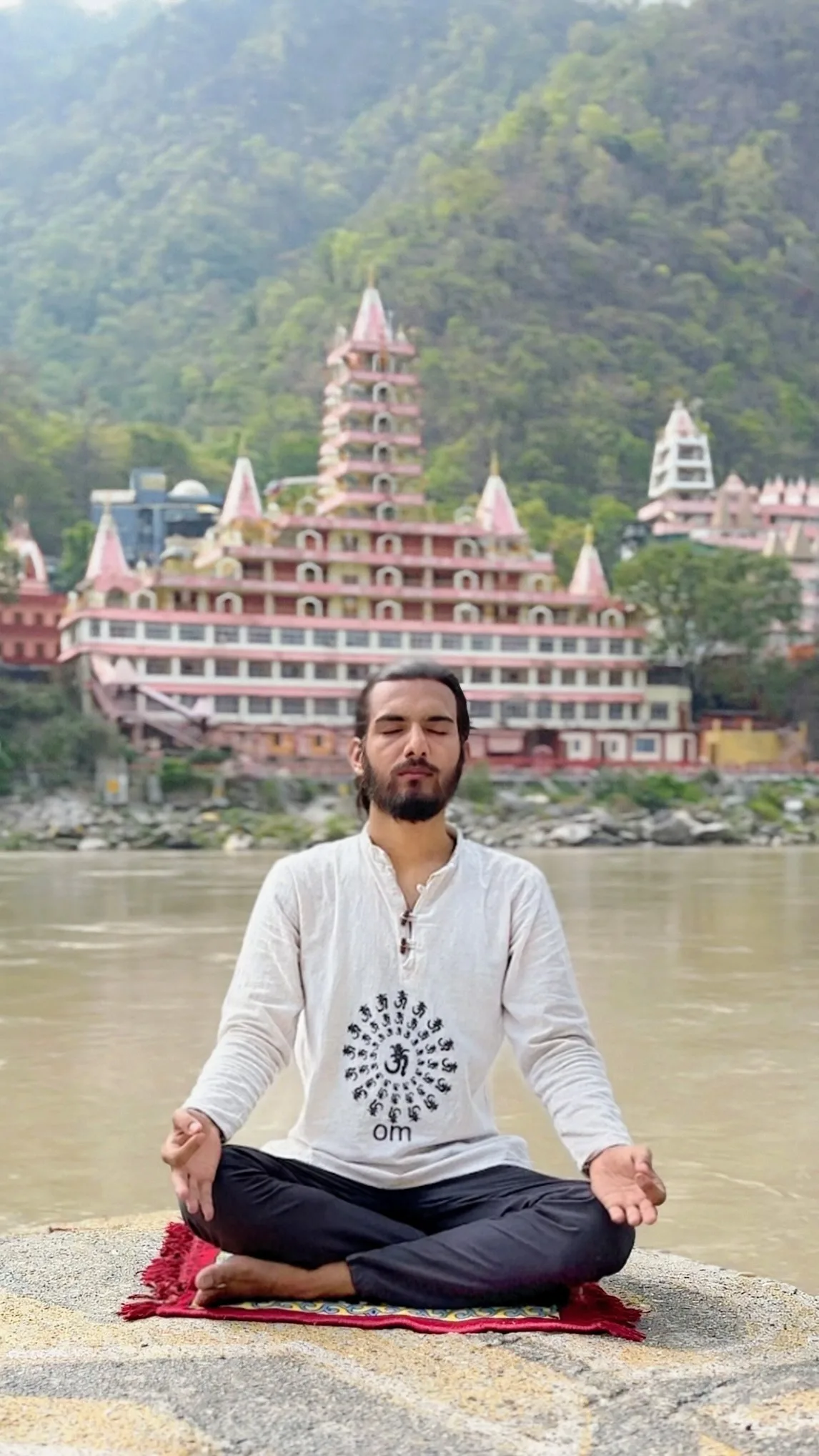
Sudhanshu Badoni
Main Teacher · Lead FacultyMain teacher at Deep Yoga, Tapovan. Runs the YogaAsana YouTube channel (4K+ subs). · 12 yrs teaching
TL;DR
Yoga philosophy is the textual and conceptual tradition behind the physical practice — codified primarily in Patanjali's Yoga Sutras (196 aphorisms across 4 chapters, composed roughly 200 BCE–200 CE), the Bhagavad Gita, the Hatha Yoga Pradipika, and the Upanishads. The eight-limbed framework (ashtanga) places asana fourth — three limbs precede it, four follow.
- Core text: Patanjali's Yoga Sutras — start here, 196 sutras, ~80 pages with commentary
- Eight limbs: yamas, niyamas, asana, pranayama, pratyahara, dharana, dhyana, samadhi
- Time to first depth: 30 hours of guided study in a RYS-200 program is the Yoga Alliance minimum
According to Yoga Alliance's published RYS-200 standards, every Registered Yoga School certification program must include at least 30 contact hours of yoga philosophy, lifestyle, and ethics for teachers — making philosophy the second-largest curriculum block after asana technique itself (Yoga Alliance RYS Standards). The depth of philosophical study is what most consistently distinguishes a serious yoga teacher training from a fitness-style certification.
What Is Yoga Philosophy?
Most international yoga students arrive at the practice through asana — the physical postures. They take a class, like how they feel, take more classes, and at some point, a teacher mentions Patanjali. They look up the name. They discover that the postures everyone is practicing are one of eight limbs of a much larger system, codified two thousand years ago, addressing not the body but the mind.
This is the moment yoga becomes interesting.
Yoga philosophy is the conceptual and textual tradition that underlies the practice. It treats the human being as a layered system — body, breath, mind, intellect, spirit — and proposes a methodology for working through those layers toward what Patanjali calls kaivalya, often translated as liberation or freedom. The asana practice that fills modern Western yoga studios is one component of this larger system, and a relatively late one.
The key insight, repeated across every classical yoga text, is that the goal of yoga is not flexibility, strength, or stress relief. Those are by-products. The goal of yoga is to still the fluctuations of the mind. As Patanjali states in the second sutra of the Yoga Sutras: yogash chitta vritti nirodhah — yoga is the cessation of the modifications of the mind-stuff.
The Four Foundational Texts
Of the dozens of yoga-philosophical texts in the Indian tradition, four form the canon that every reputable 200-hour and 300-hour teacher training engages with substantively. Read these in this order.
1. The Yoga Sutras of Patanjali
The single most important yoga text. Composed in Sanskrit roughly 200 BCE to 200 CE by the figure known as Patanjali (whose historical identity is debated but textually irrelevant). Comprises 196 short aphorisms (sutras) organized across four chapters (padas):
- Samadhi Pada (51 sutras): the philosophical foundation — what yoga is, what mind is, what consciousness becomes when stilled.
- Sadhana Pada (55 sutras): the practical methodology — the five kleshas (afflictions), the eight limbs, the ethical observances.
- Vibhuti Pada (56 sutras): the psychic powers (siddhis) that arise as side effects of advanced practice — and Patanjali's warning not to pursue them.
- Kaivalya Pada (34 sutras): liberation — the final goal of yoga and the philosophical implications of consciousness freed from identification with mind-content.
Recommended translation: Edwin Bryant's 2009 commentary edition (the most rigorous English-language scholarly translation), or for a more devotional approach, Swami Satchidananda's widely-used edition. Avoid New Age "interpretations" that paraphrase the sutras into self-help language; they consistently strip away what is most precise about Patanjali's thought.
2. The Bhagavad Gita
A 700-verse philosophical poem embedded within the larger Mahabharata epic, composed approximately 400 BCE to 200 CE. The Gita is structured as a dialogue between Arjuna, a warrior facing battle, and Krishna, his charioteer (and avatar of the divine), about how to act ethically when one's duty conflicts with one's desire to withdraw from the world.
The Gita's contribution to yoga philosophy is its articulation of three distinct yogic paths suited to different temperaments:
- Karma Yoga — the path of action without attachment to results, suited to active people in the world.
- Jnana Yoga — the path of knowledge and self-inquiry, suited to philosophical or contemplative temperaments.
- Bhakti Yoga — the path of devotion, suited to those whose primary mode of engagement is love or surrender.
Most modern asana-led practice is implicitly a form of raja yoga (the eight-limbed yoga of Patanjali) with elements of karma yoga (the practice of disciplined daily action). Recommended translation: Eknath Easwaran's edition is the most accessible to first-time readers.
3. The Hatha Yoga Pradipika
A fifteenth-century manual composed by Swami Svatmarama, codifying the physical practices that became the basis of modern Hatha Yoga. The Pradipika is more practical and prescriptive than the Sutras or the Gita — it describes specific asanas, specific pranayama techniques, the bandhas (energetic locks), and the shatkarmas (cleansing practices), along with their physical and energetic effects.
For a working pranayama practitioner, this is the canonical reference. Most of what is taught today in international yoga teacher training programs derives from the Pradipika lineage, mediated through twentieth-century teachers like Krishnamacharya, Pattabhi Jois, and Swami Sivananda. For an applied beginner's introduction to the breath disciplines the Pradipika codifies, see our pranayama techniques beginner's guide.
4. The Principal Upanishads
The earliest Indian philosophical literature, composed between 800 and 200 BCE. The Upanishads are dialogues between teachers and students exploring the nature of atman (the self) and brahman (the absolute), and the relationship between them. They predate Patanjali and the Gita and form the philosophical bedrock that those later texts build on.
You do not need to read all 108 Upanishads to do a 200-hour training. Five are sufficient: Isha, Kena, Katha, Mundaka, and Brihadaranyaka. Most reputable schools assign one or two of these as supplementary reading rather than as primary curriculum at the 200-hour level. Recommended translation: Eknath Easwaran's The Upanishads.
The Eight Limbs of Yoga
The most famous framework in yoga philosophy is Patanjali's eight-limbed system, called ashtanga (a-shta-anga, literally "eight-limbed" — not to be confused with the modern Ashtanga Vinyasa style of asana practice founded by Pattabhi Jois). Each limb is a category of practice; together they form a progressive path.
- Yamas — five ethical observances toward the world: ahimsa (non-violence), satya (truthfulness), asteya (non-stealing), brahmacharya (energy moderation), aparigraha (non-grasping).
- Niyamas — five ethical observances toward oneself: shaucha (purity), santosha (contentment), tapas (disciplined effort), svadhyaya (self-study), ishvara pranidhana (surrender to the divine).
- Asana — postural practice. In the Sutras, this means simply "a steady and comfortable seat" for meditation. The elaboration into 200+ named postures came centuries later in the Hatha tradition.
- Pranayama — breath regulation. Covered in detail in our pranayama beginner's guide.
- Pratyahara — withdrawal of the senses inward. The bridge limb — the point where outer practice transitions to inner.
- Dharana — concentration. Sustained attention on a single object.
- Dhyana — meditation. Concentration that has matured into uninterrupted flow of attention.
- Samadhi — absorption. The state in which the meditator, the object of meditation, and the act of meditation become one.
The order matters. Patanjali places yamas and niyamas first because ethical foundation is prerequisite — practice without ethical grounding is unstable. Asana and pranayama come third and fourth because the body and breath must be steady before the mind can be worked with. Pratyahara, dharana, dhyana, and samadhi are the inner four limbs — what most modern practitioners would call meditation, broadly construed.
Key Concepts Every Yoga Teacher Should Know
Beyond the eight limbs, several concepts recur across the yoga-philosophical literature. These are the terms a 200-hour student should be able to define by graduation.
Prana
Life-force or vital energy. The yogic anatomy describes prana as flowing through subtle channels (nadis) and concentrated at energetic centers (chakras). In modern interpretation, prana is often mapped to the autonomic nervous system or to the breath itself, though the classical understanding treats it as a more fundamental category.
The Five Kleshas (afflictions)
From Sutra 2.3, Patanjali enumerates the five root causes of suffering:
- Avidya — ignorance, specifically the misperception of the impermanent as permanent.
- Asmita — egoism, the conflation of the perceiving consciousness with the apparatus of perception.
- Raga — attachment to pleasure.
- Dvesha — aversion to pain.
- Abhinivesha — clinging to life, the deepest fear.
These five drive the patterns of mind that yoga practice systematically dismantles.
Samskara
Mental impressions. Every action, perception, or thought leaves a residue in the mind that conditions future patterns. Yoga practice is, in part, the deliberate weakening of unhelpful samskaras and the strengthening of helpful ones. The reason consistent daily practice matters more than intermittent intensive practice is that samskara formation is a function of repetition.
Dharma and Karma
Dharma: the right action appropriate to one's nature and circumstance. Not a universal moral code; a contextual ethical orientation. Karma: action and its consequence. The two terms are linked — dharmic action produces beneficial karmic patterns; adharmic action produces problematic ones. The Bhagavad Gita is largely a treatise on how to act dharmically when the situation is morally complex.
Purusha and Prakriti
From Samkhya philosophy (the philosophical school Patanjali draws on most heavily): the dual nature of reality. Purusha is pure consciousness, the witness; prakriti is everything else — matter, mind, emotion, intellect. The yogic project is to disentangle purusha from prakriti — to recognize that consciousness is not the content of experience but the awareness in which experience arises.
How Philosophy Is Taught at a Yoga Teacher Training
In a residential 200-hour program at Deep Yoga Wellness or any reputable Rishikesh school, philosophy is typically taught in a 90-minute classroom session immediately after breakfast — the slot in the daily schedule reserved for sustained intellectual work, when the body is fresh from morning practice and the mind is awake.
Most schools work systematically through Pada I and the opening sutras of Pada II of the Yoga Sutras over the four weeks. The Bhagavad Gita is introduced through key chapters — Chapter 2 (the foundational philosophical exposition), Chapter 3 (Karma Yoga), and Chapter 12 (Bhakti Yoga). Excerpts from the Hatha Yoga Pradipika appear when relevant to the practice (kriyas, bandhas, specific asanas). The Upanishads are typically supplementary reading rather than primary text at the 200-hour level.
The 300-hour module goes substantially deeper — full study of all four padas of the Sutras, more chapters of the Gita, and comparative work across the Hatha and Upanishadic literature. The 500-hour combined path covers both with integration. For a feel of how the 300-hour's philosophy block differs from the 200-hour's introduction, see our 300-hour what to expect article.
Where to Start Reading (Before You Arrive)
If you are preparing for a yoga teacher training and want to arrive with a working philosophical vocabulary:
- Yoga Sutras of Patanjali — Edwin Bryant translation. Read at minimum Pada I (51 sutras with commentary, ~80 pages). Take notes.
- Bhagavad Gita — Eknath Easwaran translation. Read Chapters 2, 3, 6, and 12.
- Light on Yoga by B.K.S. Iyengar — read the introductory sections (skip the asana plates for now). Iyengar's introduction is one of the cleanest summaries of yoga philosophy available in English.
- Optional: The Heart of Yoga by T.K.V. Desikachar — for a contemporary working teacher's integration of philosophy with practice.
This reading is not required to arrive at a training. But students who arrive with this preparation absorb the four-week philosophy curriculum more deeply — you build on existing scaffolding rather than starting from zero.
Common Misconceptions
Several recurring confusions appear in the Western yoga conversation worth addressing directly:
Yoga is not a religion. It is a philosophical and practical system that arose within and alongside the Hindu, Buddhist, and Jain traditions but is not theological in the way Western monotheisms are. Patanjali mentions ishvara (a special kind of divine being) but explicitly leaves the metaphysics of that being open. Practitioners of all faiths and no faith have followed yogic disciplines for centuries.
The "Ashtanga" of Patanjali is not the Ashtanga Vinyasa style. Patanjali's ashtanga is the eight-limbed framework. Pattabhi Jois's twentieth-century Ashtanga Vinyasa Yoga is one specific modern asana system that adopted the name. Both are legitimate; they are different things.
Asana is one limb, not the whole practice. The cultural shift in twentieth-century yoga elevated asana to centrality because it is the most photogenic and physically observable element. Classical philosophy treats asana as preparatory — a steady seat for meditation — not as the destination.
Sanskrit terms are not interchangeable with English equivalents. "Pranayama" is not breathwork. "Asana" is not stretching. "Dhyana" is not meditation in the Western sense. The Sanskrit terms carry specific technical meanings that the English approximations consistently flatten. Reputable schools insist on using the Sanskrit terms for this reason.
Why This Matters
The reason yoga teacher training programs in Rishikesh, Mysore, and a handful of other Indian centers maintain a substantial philosophical curriculum — when the international market would happily accept a fitness-only certification — is that the philosophy is the difference between a yoga teacher and a fitness instructor who happens to teach yoga.
A working yoga teacher who has studied the Sutras knows why the eight limbs are sequenced the way they are, why pranayama precedes meditation, why ethical foundation precedes physical practice, why the goal is not flexibility but the stilling of the mind. That knowledge changes how they sequence a class, how they cue a posture, how they hold space for a student who arrives anxious or grieving.
The philosophy is not optional. It is the part of yoga that survives the next thousand years. The asana practice in its modern form has changed substantially every fifty years; the Sutras have not changed in two millennia. They are still there, still saying what they said, still waiting for the practitioner who is ready to read them.
Begin with the second sutra: yogash chitta vritti nirodhah. Sit with it for a week. Let it become a question rather than a definition. The rest of the path follows.
Frequently asked questions
What is the main text of yoga philosophy?
The Yoga Sutras of Patanjali — 196 short aphorisms across 4 chapters, composed roughly 200 BCE to 200 CE. It is the single most important text for understanding yoga philosophy and the framework that every reputable 200-hour and 300-hour teacher training engages with substantively. Recommended starting translation: Edwin Bryant's commentary edition.
What are the eight limbs of yoga?
Patanjali's eight-limbed system (ashtanga) is: (1) yamas — ethical observances toward the world, (2) niyamas — ethical observances toward oneself, (3) asana — postural practice, (4) pranayama — breath regulation, (5) pratyahara — withdrawal of the senses, (6) dharana — concentration, (7) dhyana — meditation, (8) samadhi — absorption. The order is intentional: ethical foundation precedes physical practice; physical and breath disciplines precede the inner four limbs.
Is yoga philosophy religious?
No, not in the way Western monotheisms are. Yoga arose within and alongside the Hindu, Buddhist, and Jain traditions, but it is a philosophical and practical system rather than a theology. Patanjali mentions ishvara (a special kind of divine being) but explicitly leaves the metaphysics of that being open. Practitioners of all faiths and no faith have followed yogic disciplines for centuries.
Do I need to read the Yoga Sutras before a yoga teacher training?
Not strictly required, but strongly recommended. Students who arrive having read at least Pada I of the Yoga Sutras and key chapters of the Bhagavad Gita absorb the four-week philosophy curriculum significantly more deeply. You build on existing scaffolding rather than starting from zero. The Edwin Bryant translation of the Yoga Sutras and the Eknath Easwaran translation of the Bhagavad Gita are the standard recommendations.
What is the difference between Patanjali's Ashtanga and Ashtanga Vinyasa Yoga?
They are different things. Patanjali's ashtanga (composed roughly 200 BCE) is the eight-limbed philosophical framework — yamas, niyamas, asana, pranayama, pratyahara, dharana, dhyana, samadhi. Ashtanga Vinyasa Yoga is a specific modern asana system founded by Pattabhi Jois in twentieth-century Mysore. Both are legitimate; they are unrelated except for sharing a name.
How much philosophy is taught in a 200-hour yoga teacher training?
Yoga Alliance requires a minimum of 30 contact hours of philosophy, lifestyle, and ethics for teachers in any RYS-200 program — making philosophy the second-largest curriculum block after asana technique. Most reputable schools work systematically through Pada I and the opening of Pada II of Patanjali's Yoga Sutras, plus key chapters of the Bhagavad Gita, plus excerpts from the Hatha Yoga Pradipika where relevant to practice. The 300-hour module goes substantially deeper into all four padas of the Sutras and comparative work with the Upanishads.